The Nazca Lines are a group of huge geoglyphs, line drawings that, seen from a distance, appear to be etched into the surface of the arid Pampa Colorada (“Red Plain”), northwest of the city of Nazca in southern Peru. They spread across an area of almost 500 square kilometers (190 square miles).
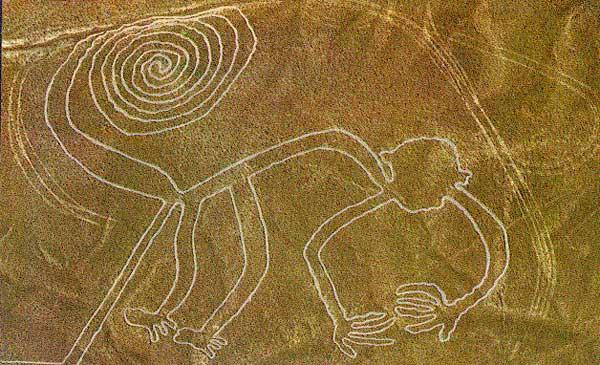
Most of the lines were made more than 2,000 years ago by the Nazca culture (c. 200 BCE – 600 CE), although some clearly predate the Nazca and are attributed to the earlier Paracas culture. The Paracas-era figures tend to be human-like and resemble even older petroglyphs found in the region, while the Nazca figures are mostly plants and animals: a monkey some 110 meters (360 feet) long, a killer whale (65 meters / 210 feet), a condor-like bird (135 meters / 443 feet), a hummingbird (50 meters / 165 feet), a pelican (285 meters / 935 feet), a spider (46 meters / 150 feet), and a variety of flowers, trees and other plants, along with geometric shapes such as triangles, trapezoids and spirals. The figures are practically impossible to make out from the ground, which is why a scenic flight is the best way to appreciate them, although some believe their true meaning can only be grasped by walking what may have been sacred paths.