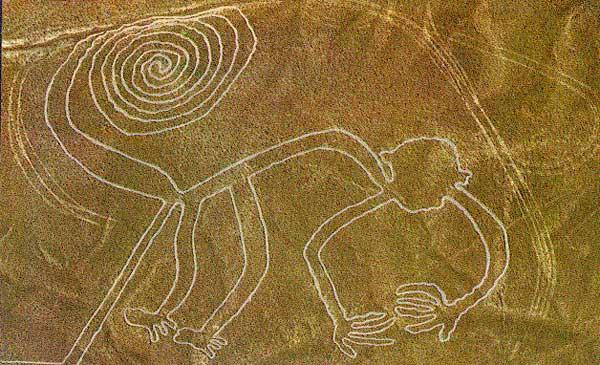
Nazca Lines, groups of geoglyphs, large line drawings that appear, from a distance, to be etched into Earth’s surface on the arid Pampa Colorada (“Coloured Plain” or “Red Plain”), northwest of the city of Nazca in southern Peru. They extend over an area of nearly 190 square miles (500 square km).Aerial view of Nazca Lines, on the Pampa Colorada, northwest of the city of Nazca, Peru
Most of the Nazca Lines were constructed more than 2,000 years ago by the people of the Nazca culture (c. 200 BCE–600 CE), though some clearly predate the Nazca and are considered to be the work of the earlier Paracas culture. While the images dated to the Paracas are often humanlike and bear some resemblance to still earlier petroglyphs in the region, the subjects of the Nazca-made lines are generally plants and animals—such as a monkey (some 360 feet [110 metres] long), a killer whale (210 feet [65 metres]), a bird resembling a condor (443 feet [135 metres]), a hummingbird (165 feet [50 metres]), a pelican (935 feet [285 metres]), a spider (150 feet [46 metres]), and various flowers, trees, and other plants—as well as geometric shapes, including triangles, trapezoids, and spirals. Although the figures have been said to be virtually indecipherable from ground level, some claim that one cannot understand their meaning without walking what are now believed by some to be the sacred paths.